
Hustlers and Visionaries

Hustlers and Visionaries

Start-up of Start-ups

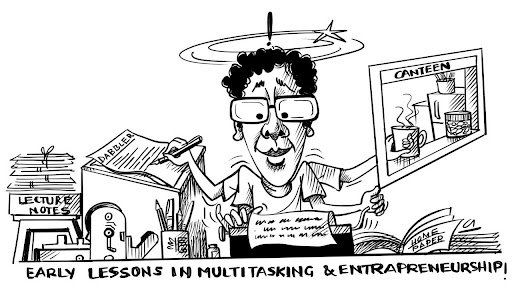
When did the ‘start-up’ culture start in IITB? I don’t exactly know, but let me tell you about some start-ups that occurred in the late nineteen sixties. I ducked in my second year at IIT, so 1966-67 was a year that had to be gone over again. It started badly – before I could even come to the campus, my father informed me that his business investments had resulted in his becoming broke. There was a meagre pension he was getting, and the fees and mess bills would be beyond him. And since I had failed, I had to think about dropping out of IIT or see what could be done. I came back to my room at IIT and analyzed. Was I going to pack up and leave, or was I going to find a way to get my financial requirements? The problem was only about paying for tuition fees, which at that time was fairly meagre, and mess bills, which were like hundred rupees per month. How do I earn about two hundred rupees a month to cover all the costs? And immediately, I hit upon the first job. Those were the days when fifth year undergrads had to submit ‘home papers’ – a kind of thesis or project report, going into 40 or more pages, which all had to be typed, as at that time there were no computers and the like. If I could type eight or ten home papers, it would see me through for a while. I got an old Remington type-writer from home to start on my new venture. In those days, clerical staff at the main building would type out the home papers, and charge seventy-five paise per page. And most students were dissatisfied, because all the formulae they had to insert in the home papers had superscripts and subscripts which the clerical staff would garble into a mess, and lead to retyping of pages, which of course had to be paid for. I offered to type out home papers at fifty paise per page. The first couple of guys, one from civil and another from chemical, helped me a lot – when they saw that their superscripts and subscripts came right the first time, they did enough ‘dindora peeting’ on my behalf in their class for me to have enough business for the season. In fact, I ended up typing a lot of home papers for three years. One benefit of the home paper business is that I had to read through and type out home papers of almost all departments, which gave an excellent exposure to all branches of engineering, much better than all that I learnt in class subsequently! The home paper season ended by November, and I was again staring down the barrel. A Science Congress was being held at IIT in December, where delegates would come from all over the country and get accommodated in the hostels. I volunteered to help, and was there to receive the guests coming to Hostel V. One by one they came, and went up to their allotted rooms, and one by one they came back, with requests about where to buy combs, toothpaste, and the like. By that evening, the first ‘canteen’ was set up in Hostel V, where snacks like ham sandwiches could be had, as well as all the odds and ends such as combs and toothbrushes. My recovery through the canteen business over the December vacation was good enough to take my finances forward, but there were a lot of left-over stocks. I donated these to one of the mess servants, and I asked him to run the canteen on his own from then on, and a lot of students patronized the canteen. Helping someone else set up in a business is an unalloyed joy. It certainly gives more pleasure than all the money you can make for yourself! I used to be a fairly good student, attending class regularly, and taking copious notes on foolscap pages that I neatly filed away. The next business that I got into used my laborious notes, which I now cut into stencils, and printed copies of it, and sold to my classmates. It started with Logic and Ethics, and then went on to Strength of Materials, IC Engines, and a whole gamut of subjects. This became my source of livelihood for quite some time. My good friend and room-mate Chandru Chainani ducked in the third year, and asked me for the stencils of the lecture notes, as ducking gave him a new batch to sell the notes to! Chandru was an exceptionally good student, and very sharp, but unfortunately he took close to ten years to graduate. I always wonder whether he took that long because of any problems, or because he was too busy selling the notes that he took from me! My good friend Mohan Dalal was the Hostel Secretary at that time. He came up to me and asked me if I could produce a Hostel Magazine. I was game for it, but Mohan had restrictions on it – the magazine had to have two columns per page, and each column had to be fully justified (i.e., sharp edge on both left and right). I agreed to that. And that is how The Dabbler came into being. I had to cut stencils for each page. Which meant that I had to write each line of each column, count the number of characters in it, and add spaces in between to make that line justified, then type it without any error on the stencil sheet. And then take the stencils and get two hundred and fifty front-back copies made. And all this, every alternate week, as the magazine was a fortnightly. (It had to be fortnightly, because on alternate weeks, I was working on the production and distribution of class notes!) Four foolscap pages of this is no mean achievement! And of course, I had to compose all
Hustlers and Visionaries

Looking Back with Mr. Sharad Saraf: IITB in the ’60s

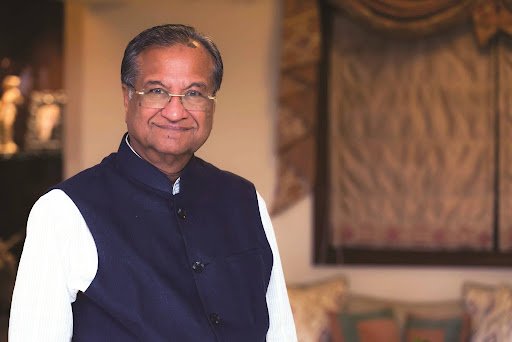
Interviewers: Adil Khan, Samyak Shah This interview was conducted as part of Department of Electrical Engineering’s “Alumni and Corporate Engagement” initiative. Check out the Department’s official student newsletter at this link.   Mr. Sharad Saraf is an alumnus of IIT Bombay (B.Tech. ’69 Elec. Engg. H2) and has also served as a member of the Board of Governors (BoG) of IIT Bombay. He is the Chairman cum Managing Director of Technocraft Industries, an established multinational industrial house which he co-founded along with his brother in 1972. Mr. Saraf has headed several chambers of commerce and is also the current Chairman of the Board of Governors, IIT Jammu. He is also a founding member of the Electrical Engineering Student’s Association (EESA) and hence, we decided to talk to him about his experiences and also find out how life was at IITB in his undergraduate days.   As an alumnus, can you let us know what life was like at IITB in your days? We were very carefree and relaxed. We did not have so many cultural and other events. The campus was lush green with a very pleasing ambience. There was a great bonding among the batch mates mainly because there were no other disruptions like mobile phone, laptops etc. What kind of extracurricular activities did students participate in those days? Our extra-curricular activities consisted of inter hostel, inter IIT sports competitions, various types of inter hostel activities, hostel day etc. We also produced very high quality professional plays which were staged in Tejpal Auditorium, Mumbai. There was great stress on sports.   How was the faculty – student interaction back then when the batch strength was lower? Faculty – student interaction was very personal. The professors in the department knew almost all the students. The faculty members were ever ready to meet the students or resolve any issues.   How did the idea of forming EESA (Electrical Engineering Students’ Association) come about? At our time when I was in my 4th year, I found that there was a very vibrant Chemical Engineering Students Association. So I wondered why we did not have a similar association for the Electrical Department. I discussed this with senior professors like Hariharan, Balakrishnan, Mukherjee among others and they were extremely kind and helpful.   What were the plans that you had while forming EESA and in what manner did the department support it? The main plan was factory and plant visits that would enhance student’s knowledge of electrical engineering. For example, we visited Tarapur Atomic Power Station and a factory in Vadodara. There were also a few other visits. These visits were the source of bonding among members and we also had interesting lectures. The faculty was extremely co-operative and never said no for any program or event.   What were the factors that affected career choices in those days and what went behind you choosing the path of entrepreneurship? In those days the most favorite choice was to go to the US for higher studies. Almost 70% of my batch mates went to the US. Those who stayed back did so for various reasons like family issues, financial conditions, family businesses or simply the desire to do something in the country. I could say that I was kind of a born entrepreneur. Even during my stay in the hostel, I had set up small commercial activities which were great fun and also well liked by my hostel batch mates. I came from a traditional Marwari community and hence I had it in my DNA. After graduating, I worked in a factory manufacturing electric motors, and then in 1972 I established my own business.   Looking back, how was the entrepreneurial scene in the 1970s, especially at IITB as compared to what it is now? In those days there was hardly any entrepreneurial spirit in our IIT students. There was no SINE or IT Sector. Hence almost all students preferred to go for professional jobs.   How did you familiarise yourself with taxation, personal finance and other things that are important in daily life but aren’t taught in the IITB classroom? Many people have asked me this question. All non-technical services like taxation, personal finance etc. are available through chartered accountants and other professionals. I do not think there is a great need for any formal teaching of these subjects since there is not much creativity involved in them but general knowledge of taxation and personal finance comes on its own by experience.   Could you please illustrate how the IIT Bombay network and peer group help you throughout your career? Till mid 1980s there was no IITB networking except for among close batch mates or hostel mates. There was no email, mobile phone etc. and hence networking was restricted to landline phones. However, in the 1980s I started the IITB Alumni Association (Bombay Chapter). This became quite popular and finally spawned IITBAA and PAN IIT Alumni Association. We organized a monthly alumni meet in the Institute of Engineers, Mahalaxmi on the last Saturday of every month. We also did a lot of events including organizing an annual day on the last Sunday of every year.   What would be your advice to students who are currently at IITB? Basically all IITB students are quite creative, intelligent and dedicated. My advice is to remain focused, and have a CAN DO attitude. You will also find opportunity in every adversity provided you look for it intelligently.   We came to know that you are soon coming up with a book on your life experiences. Would you like to share anything about that? Yes, my book is under printing now. It is called Engineering Karma and contains certain important events and experiences from my life which carry some message. There are also chapters about my experience at IIT Bombay, the first 4 years of my career and also my subsequent business journey.

Hustlers and Visionaries

Pratham: The First Student Satellite of IIT Bombay

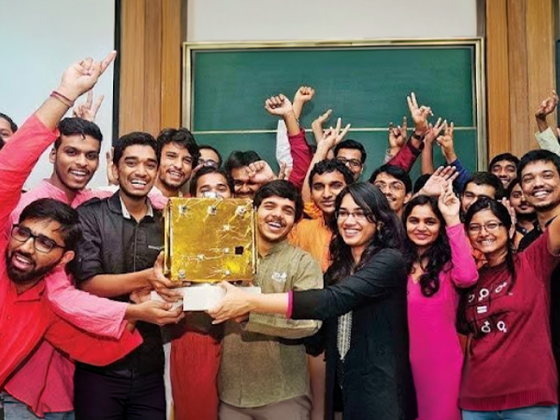
Pratham, the student satellite of IIT Bombay, was conceptualised in 2008 with the aim of making the institute a center for space science and technology research. The satellite is designed to fit within a cube of 30-cm side weighing nearly 10 kg. Among the mission objectives of Pratham, empowering the students involved with the skill set required to develop a satellite through various stages of design, analysis, fabrication and testing is at the forefront.  Along with the scientific objective of Pratham, one of the goals of this project was to share with society the knowledge that we have been privileged to acquire, being in one of the premier institutes of the country. The vision in mind was to start collaboration between various Indian universities interested in contributing to the space sector and ensuring sharing of knowledge and facilities between them. Pratham was to be the first step towards that goal. To realise that, various workshops and sessions have been conducted by the team in our own institute and other universities as well. A project related to satellite and space technology needs time to realise things which can go wrong because unlike other projects, space doesn’t provide a second chance to rectify things. The project started in the later part of 2007 when Prof. Vahia of TIFR suggested to the IIT Bombay third year students to do something related to satellite building at IIT Bombay. Those third year students (Saptarshi Bandyopadhyay and Shashank Tamaskar) approached the then HOD of Aerospace Department, Prof K. Sudhakar, and the institute. Though IITB has experts in fields like electronics, controls, and structures, no one had firsthand experience about what it takes to build a satellite. As suggested by the professors, a literature survey was started. Building a satellite or anything related to space takes lots of investment, time and patience. The institute had a genuine apprehension that like most of the other projects, students will work for a year or so, they will spend IIT money and then there will be no one to continue the work. To solve this problem the team came up with a system to maintain continuity which is described in detail below. An initial core group team was inducted and ground work for the satellite building started. After six months of rigorous ground work, the team presented all the findings related to satellites, especially student satellites (SS), design features of SS (like low cost, off-the-shelf components, etc), subsystems of satellites. The team demonstrated their interest and presented a continuation plan to the institute. A project related to satellite and space technology needs time to realise things which can go wrong because unlike other projects, space doesn’t provide a second chance to rectify things. The design process has two parts: technical and non-technical. Both are interdependent. Decisions of one part affect the other. The technical part involves everything that is related to technology and engineering. The non-technical part involves deciding mission, vision statements, success criteria, deadlines, budget and coordinating with IIT, ISRO.The biggest challenge of the project has been the survival of the project. The starting team will have left the institute when the team that finishes the project is inducted. For this, strong foundations of technical as well as non technical activities are very important. The project has gone through several design reviews: 20 reviews with mentor professors, 4 institute wide reviews with professors from various departments of IITB, and 6 reviews with ISRO scientists. Official reviews with ISRO included 3 design reviews, 3 testing reviews, including one just before the launch for the launch clearance.The Pratham project took more than 8 years to reach its success. There were many factors that played a crucial role in managing things properly over this period. Pratham team: 2013-2014 Pratham team: 2010-2013 Team selection:  Every year, around September, a selection test is conducted which is open to all the students of the institute. The selection test consists of a quiz to screen the candidates and judge them on the basis of their approach to a problem. The selected candidates then are allotted a mini-project related to satellite work and a mentor from the senior team to help them in understanding the problem. This round is to guage their enthusiasm for satellite related work. After a week, they have to give a presentation on the topic that was given to them. After successfully clearing this selection procedure, the candidate is inducted into the team as a temporary member. After working with the team for the next 2-3 months, they are given core-group membership if the team is satisfied with their work, dedication, and commitment. In this manner, a new batch of students is inculcated every year to replace the old out-going batch. Since the old out-going batch leaves around April, it gives the new batch about 7 months to learn about the Satellite from their seniors. Project student leader selection:  As they say you just need one person to make a change and it is very much true in this case also. Project student leader is that person who holds all things together and sails the ship through all the ups and downs and all the weathers. Being a student project, no one gets paid and one can leave whenever they want. Keeping the project going and students motivated in the midst of so many activities on campus, academics, personal life, makes the job of leader that much harder. So the selection of the leader is very crucial. Most important qualities for the leader are attitude and commitment. Once the person has this basic qualities then it is a job of the previous leader to groom that person into leader. As they say hire for the attitude and train for the skills. We also employed the same principle. Documentation:  The team has documented each and every level of design, analysis, fabrication and testing which occurred at various stages of satellite making. There had been more than 6 reviews with ISRO and many more

Scroll to Top