
Pratham: The First Student Satellite of IIT Bombay
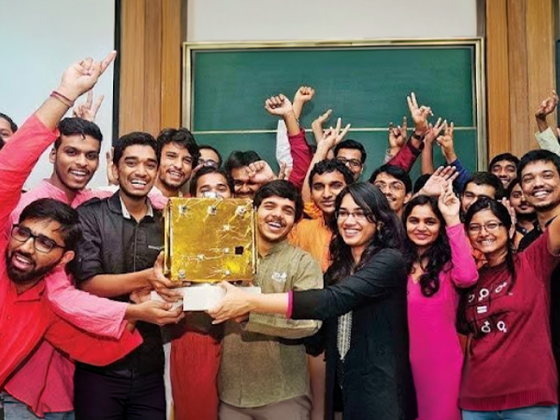
Pratham, the student satellite of IIT Bombay, was conceptualised in 2008 with the aim of making the institute a center for space science and technology research. The satellite is designed to fit within a cube of 30-cm side weighing nearly 10 kg. Among the mission objectives of Pratham, empowering the students involved with the skill set required to develop a satellite through various stages of design, analysis, fabrication and testing is at the forefront. Along with the scientific objective of Pratham, one of the goals of this project was to share with society the knowledge that we have been privileged to acquire, being in one of the premier institutes of the country. The vision in mind was to start collaboration between various Indian universities interested in contributing to the space sector and ensuring sharing of knowledge and facilities between them. Pratham was to be the first step towards that goal. To realise that, various workshops and sessions have been conducted by the team in our own institute and other universities as well. A project related to satellite and space technology needs time to realise things which can go wrong because unlike other projects, space doesn’t provide a second chance to rectify things. The project started in the later part of 2007 when Prof. Vahia of TIFR suggested to the IIT Bombay third year students to do something related to satellite building at IIT Bombay. Those third year students (Saptarshi Bandyopadhyay and Shashank Tamaskar) approached the then HOD of Aerospace Department, Prof K. Sudhakar, and the institute. Though IITB has experts in fields like electronics, controls, and structures, no one had firsthand experience about what it takes to build a satellite. As suggested by the professors, a literature survey was started. Building a satellite or anything related to space takes lots of investment, time and patience. The institute had a genuine apprehension that like most of the other projects, students will work for a year or so, they will spend IIT money and then there will be no one to continue the work. To solve this problem the team came up with a system to maintain continuity which is described in detail below. An initial core group team was inducted and ground work for the satellite building started. After six months of rigorous ground work, the team presented all the findings related to satellites, especially student satellites (SS), design features of SS (like low cost, off-the-shelf components, etc), subsystems of satellites. The team demonstrated their interest and presented a continuation plan to the institute. A project related to satellite and space technology needs time to realise things which can go wrong because unlike other projects, space doesn’t provide a second chance to rectify things. The design process has two parts: technical and non-technical. Both are interdependent. Decisions of one part affect the other. The technical part involves everything that is related to technology and engineering. The non-technical part involves deciding mission, vision statements, success criteria, deadlines, budget and coordinating with IIT, ISRO.The biggest challenge of the project has been the survival of the project. The starting team will have left the institute when the team that finishes the project is inducted. For this, strong foundations of technical as well as non technical activities are very important. The project has gone through several design reviews: 20 reviews with mentor professors, 4 institute wide reviews with professors from various departments of IITB, and 6 reviews with ISRO scientists. Official reviews with ISRO included 3 design reviews, 3 testing reviews, including one just before the launch for the launch clearance.The Pratham project took more than 8 years to reach its success. There were many factors that played a crucial role in managing things properly over this period. Pratham team: 2013-2014 Pratham team: 2010-2013 Team selection: Every year, around September, a selection test is conducted which is open to all the students of the institute. The selection test consists of a quiz to screen the candidates and judge them on the basis of their approach to a problem. The selected candidates then are allotted a mini-project related to satellite work and a mentor from the senior team to help them in understanding the problem. This round is to guage their enthusiasm for satellite related work. After a week, they have to give a presentation on the topic that was given to them. After successfully clearing this selection procedure, the candidate is inducted into the team as a temporary member. After working with the team for the next 2-3 months, they are given core-group membership if the team is satisfied with their work, dedication, and commitment. In this manner, a new batch of students is inculcated every year to replace the old out-going batch. Since the old out-going batch leaves around April, it gives the new batch about 7 months to learn about the Satellite from their seniors. Project student leader selection: As they say you just need one person to make a change and it is very much true in this case also. Project student leader is that person who holds all things together and sails the ship through all the ups and downs and all the weathers. Being a student project, no one gets paid and one can leave whenever they want. Keeping the project going and students motivated in the midst of so many activities on campus, academics, personal life, makes the job of leader that much harder. So the selection of the leader is very crucial. Most important qualities for the leader are attitude and commitment. Once the person has this basic qualities then it is a job of the previous leader to groom that person into leader. As they say hire for the attitude and train for the skills. We also employed the same principle. Documentation: The team has documented each and every level of design, analysis, fabrication and testing which occurred at various stages of satellite making. There had been more than 6 reviews with ISRO and many more