
H10: Lessons Beyond the Classroom
IITB was a very special place. H10 at IITB was an even more special place.
In my first semester, my brother was in town on a visit. We went out to dinner with a friend. It got pretty late by the time we finished close to midnight. By then, worries had been expressed numerous times: What is the closing time in your hostel? They were far more anxious than I was, which was precisely zero on a scale of 0 to 10. That amazed them.
When I said, “There’s no such thing,” they were incredulous. How could a girls’ hostel exist without restrictions? They were mightily impressed. All the way from Bandra to Powai, as they dropped me back, they kept asking the same question. This was 1980, and the notion that hostels for women could exist without such rules was simply difficult to believe. Even today, many working women’s hostels have curfew times.
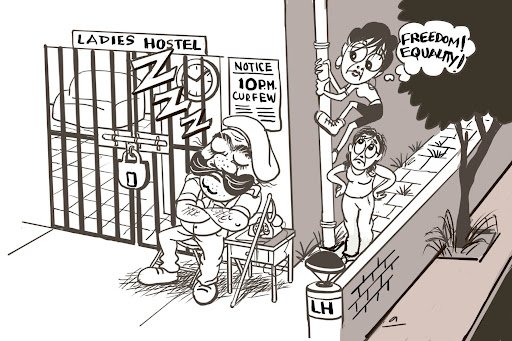
Little did they know how my seniors among whom was one famous “hunterwali” , had fought against unfair restrictions. I had heard the stories. I knew about the name change (LH to H10), the lifting of gender-biased rules, and how these remarkable women had defied restrictions by climbing down water pipes and leaving the hostel after the gates were locked. Inspired by these stories, I remember climbing down from the first-floor corridor myself, using the pipe for support, just for the fun of it.
But it was not simply about curfew. In many places, men were not allowed inside women’s hostels—not even fathers, brothers, cousins, or classmates. In H10, boys could visit, provided they were met and escorted by a hostel resident. It seemed perfectly reasonable. Why should classmates not be able to study, chat, or spend time together simply because they were of the opposite sex?
The atmosphere in H10 was one of genuine gender equality. Although I came from a background where this was taken for granted, I learned that it was not the norm everywhere. More importantly, I learned that unfair rules could be questioned, challenged, and changed. In some way, this undoubtedly contributed to a sense of empowerment.
A few years later, while staying in a hostel at an institute in Bangalore, I experienced this lesson firsthand. Friends both women and men would visit in the evenings, and we would sit on the lawn or in my room discussing weekend hiking and climbing plans. Unknown to us, the administration had imposed restrictions on visitors.
I found out when a friend’s mother came to invite me to her daughter’s wedding. She arrived with the invitation card in hand, only to be stopped at the gate because “visitors were not allowed after office hours.” I was furious.
I confronted the administrative officer. He insisted the rules were for my protection. I pointed out that I was well over eighteen and that he had no right to dictate my personal life or whom I could meet in my free time. Eventually, he said he could do nothing and suggested I meet the Director.
So I did.
I asked simple questions:
Do you want social visits to take place during office hours? I am over eighteen. How can you restrict my life outside working hours?
When he could not answer, he fell back on the familiar excuse: “It’s a security issue.”
That opened the door for another question. How exactly was a fifty-year-old woman carrying a wedding invitation a security threat?
Finally, he agreed to my proposal: visitors could enter if the hostel resident met them at the gate and took responsibility for them. I refused to leave until he picked up the phone and instructed the administrative officer accordingly.
It was as simple as that.
Ask the right questions, and if there are no answers, absurd rules can be changed.
The lessons learned subconsciously in H10 came in handy every time I encountered something unfair. Had H10 accepted those restrictions meekly, I might have assumed that “that’s just the way things are.” But H10 taught me that things did not have to be that way.
For that, I will always be grateful.